

Quick Guide: Which Air Compressor Is Right for You?
| Your Requirement | Recommended Type | Why? |
| A factory operating in shifts or 24/7 | Rotary Screw Compressor | Continuous airflow and extended operation |
| Variable air demand throughout the day | VSD Rotary Screw Compressor | Adjusts motor speed according to actual demand |
| Food, pharmaceutical, and medical industries | Oil-Free Air Compressor | No oil is injected into the compression chamber |
| Workshop or intermittent operation | Piston Air Compressor | Lower initial cost and operation when needed |
| Large industrial facility with extremely high airflow demand | Centrifugal Air Compressor | Designed for very high capacities |
What Is an Air Compressor and Why Does It Matter to Your Factory?
An air compressor is a machine that draws atmospheric air and compresses it to power machinery, pneumatic tools, packaging lines, and control systems.
In many factories, compressed air is one of the largest electricity consumers after the main production motors. Choosing the wrong compressor can therefore affect your electricity bill every month and lead to production downtime.
The required specifications vary according to four main factors: airflow demand, operating pressure, operating hours, and the air quality required by your industry.
Best Types of Air Compressors for Industrial Applications
1. Rotary Screw Air Compressor: Best for Continuous Operation
Best for: Factories operating in shifts, including plastic, textile, metalworking, and packaging facilities.
A rotary screw air compressor compresses air between two intermeshing screw rotors, producing a continuous and smooth airflow, typically with lower noise and vibration levels than piston compressors.
Rotary screw compressors are available in fixed-speed and VSD configurations, including models equipped with permanent magnet motors. They are also available in oil-injected and oil-free designs.
For more details about available models, explore B&D Rotary Screw Air Compressors.
You can also read our Rotary Screw Air Compressor Guide for Factories to understand how these compressors work and how to select the right capacity.
2. Oil-Free Air Compressor: Best for Food and Pharmaceutical Industries
Best for: Food and beverage manufacturing, pharmaceutical production, medical supplies, and electronics.
An oil-free air compressor compresses air without injecting oil into the compression chamber, reducing the risk of oil contamination at the source.
Oil purity in compressed air is classified according to the international standard ISO 8573-1, where Class 0 represents the highest specified oil-purity classification.
It is important to understand that “oil-free” does not mean “moisture-free” or “dust-free.” Compressed air may still require suitable dryers and filters to meet the required air quality.
Explore our available Oil-Free Air Compressors.
3. Piston Air Compressor: Best for Workshops and Intermittent Applications
Best for: Maintenance workshops, automotive workshops, and light-duty applications.
A piston air compressor operates by moving a piston back and forth inside a cylinder to compress air.
It generally has a lower initial purchase cost and is suitable for applications that require compressed air intermittently.
However, when used for long and continuous operating periods, heat generation, maintenance requirements, and noise levels become important factors to compare against rotary screw compressors before making a decision.
4. Centrifugal Air Compressor: Best for Large Industrial Facilities
Best for: Large industrial complexes and centralized compressed air systems with extremely high airflow requirements.
A centrifugal compressor uses a high-speed rotating impeller to increase air velocity and convert that velocity into pressure.
It is not usually the most economical choice for small and medium-sized factories. Its suitability should be evaluated through performance curves and actual load requirements.
Quick Comparison of Air Compressor Types
| Compressor Type | Operating Conditions | Noise and Vibration | Main Applications |
| Rotary Screw | Continuous and extended operation | Relatively low | Factories and production lines |
| Oil-Free | Depends on the design | Model-dependent | Food, pharmaceutical, and medical industries |
| Piston | Intermittent operation | Generally higher | Workshops and light-duty applications |
| Centrifugal | Continuous operation with high capacities | Design-dependent | Large industrial facilities |
Note: These categories can overlap. A rotary screw compressor, for example, can be oil-injected or oil-free, and may operate at fixed speed or with VSD technology.
Fixed-Speed vs. VSD Air Compressors: What’s the Difference?
A fixed-speed compressor operates at a constant motor speed and manages changes in air demand through load and unload cycles. It is suitable when air consumption remains relatively stable.
A Variable Speed Drive (VSD) compressor automatically adjusts motor speed according to actual air demand. This helps reduce unnecessary operation and improve energy efficiency when air consumption fluctuates throughout the day.
B&D indicates that electricity savings of up to 30–40% may be achievable under suitable operating conditions. However, actual savings vary from one factory to another. This is why we assess your air consumption before recommending a specific model.
The Compressor Alone Is Not Enough: Understanding a Complete Compressed Air System
System efficiency depends on how its components work together.
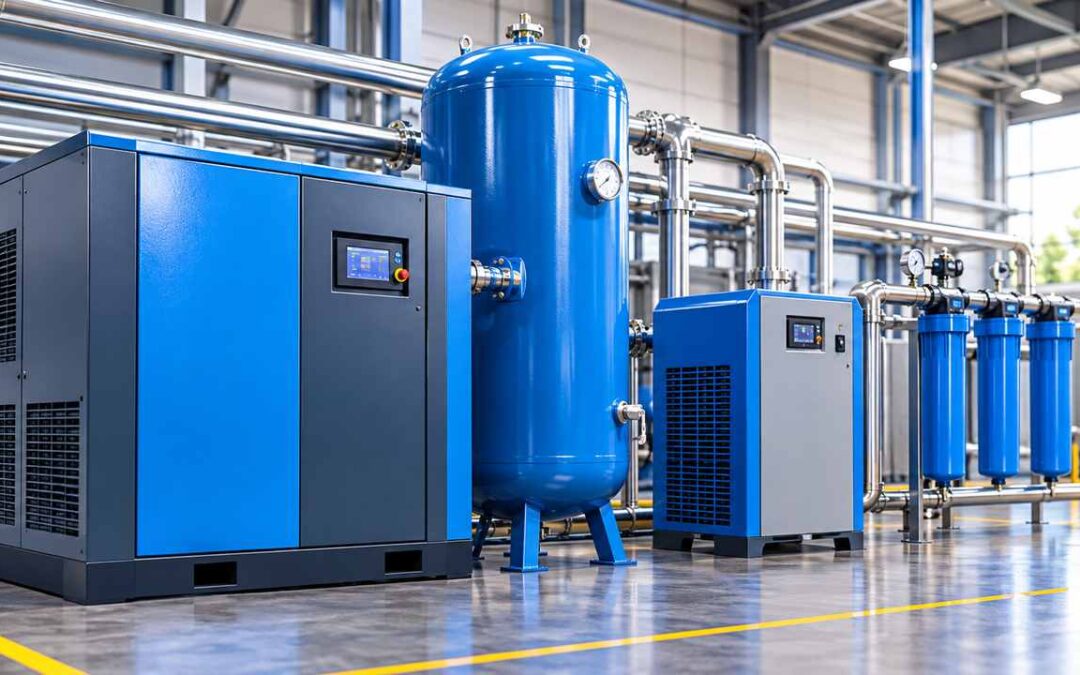
- Compressed Air Storage Tanks: Store compressed air, stabilize system pressure, and help reduce compressor load and unload cycles.
- Air Dryers: Reduce water vapor that can cause pipe corrosion and damage pneumatic tools. Refrigerated dryers are commonly used for general applications, while desiccant dryers are suitable for applications requiring lower dew points.
- Compressed Air Filters: Remove dust particles, liquid water droplets, and oil contaminants, depending on the filter type and grade. They do not replace air dryers for removing water vapor.
We can also design a complete system for your factory, including a ready-to-operate compressor room, instead of sourcing individual components from multiple suppliers.
Compressed Air Quality: ISO 8573-1 Explained
The ISO 8573-1 standard classifies compressed air purity across three main contaminant categories:
- Solid particles
- Water
- Oil
Each industry requires specific air quality classes depending on its application. For example, the compressed air used in a food packaging line may require different purity levels from the air used in a general maintenance workshop.
Before recommending a compressor and air treatment equipment, ask your supplier to identify the required air quality classes for your application.
What Factors Affect Air Compressor Prices?
There is no single price for all air compressors. The cost depends on several technical and operational factors, including:
- Power and airflow capacity: Measured in m³/min or CFM, along with the required operating pressure.
- Control technology: Fixed-speed or VSD.
- Compressor design: Oil-injected or oil-free.
- System components: Air storage tank, dryer, and filters.
- Additional requirements: Installation, operator training, and maintenance contracts.
More importantly, compare the total life-cycle cost (electricity, maintenance, and downtime), rather than focusing only on the initial purchase price. Electricity usually represents the largest share of an air compressor’s operating costs.
How to Choose Among Air Compressor Suppliers in Egypt
When comparing air compressor suppliers in Egypt, do not make price your only deciding factor. Evaluate the following five points:
- Authorized dealership and supply source: Is the company an authorized agent or distributor of the brand? Ask for proof of its authorization.
- Technical assessment before quotation: A reliable supplier should ask about your airflow demand, operating pressure, working hours, and industrial application before recommending a model or providing a price.
- Spare parts and maintenance: Are genuine spare parts available locally? How quickly can a technician respond in an emergency?
- Air treatment solutions: Can the supplier provide the air tank, dryer, and filters together with the compressor?
- Warranty and after-sales support: What is the warranty period, what does it cover, and does it include installation, commissioning, and operator training?
Air Compressor Importers vs. Authorized Dealers: What You Should Know
The Egyptian market includes two main types of suppliers: commercial importers, who purchase equipment from different sources and resell it, and authorized agents or distributors, who have a direct relationship with the manufacturer.
When searching for air compressor importers in Egypt, it is important to ask the following questions:
- Is there local stock of genuine spare parts in Egypt, or must they be ordered when needed?
- Is the warranty provided by the manufacturer or only by the supplier?
- Are there technicians trained to service this specific brand?
- What happens to technical support if the supplier stops importing that particular model?
The difference between suppliers may not be obvious on the day of purchase, but it becomes clear when the first breakdown occurs. Even one hour of production downtime can cost more than the initial price difference.
B&D Air Compressor: Complete Industrial Solutions from El Mohandes Company
When searching for B&D Air Compressor solutions in Egypt, El Mohandes Company provides an integrated range of compressed air equipment as an authorized agent and distributor of B&D compressors in the Egyptian market.
Available solutions include:
- Rotary Screw Air Compressors with fixed-speed and VSD configurations, including permanent magnet motor technology.
- Oil-Free Air Compressors for sensitive industrial applications.
- Air Storage Tanks, Air Dryers, and Compressed Air Filters to complete the compressed air system.
- Technical Services including free consultation, air demand assessment, ROI calculations, installation, commissioning, operator training, and preventive maintenance.
- 24/7 technical support, warranties of up to 18 months, and genuine spare parts.
- Coverage across Egypt through its branches in Qalyub and 10th of Ramadan City, with export capabilities.
Learn more about El Mohandes Company and its industrial solutions for metalworking and CNC, plastics, textiles, food processing, and packaging industries.
Related Articles
- Rotary Screw Air Compressor Guide: Choosing the Heart of Your Compressed Air System
- B&D Rotary Screw Air Compressors
- Oil-Free Air Compressors
- Compressed Air Storage Tanks
- Air Dryers
- Compressed Air Filters
Get a Free Technical Consultation Before Making Your Decision
Tell us about your factory’s industrial activity, operating hours, and required pressure. Our team will recommend the most suitable compressed air system and help calculate the expected return on investment before you purchase.
El Mohandes Company – Authorized B&D Agent in Egypt
- Phone: 01070133251 (Sunday–Thursday, 9:00 AM–5:00 PM)
- Email: b.d.aircompressor.egypt@gmail.com
- Branches: Qalyub – Qalyub–El Qanater Road, next to El Deeb Ceramics | 10th of Ramadan City – Sama Mall Market, Fourth Phase
- Request a Free Quote Now
Frequently Asked Questions
What Are the Best Types of Air Compressors for Factories?
Rotary screw compressors are suitable for many factories because they provide continuous airflow and support extended operating hours. Oil-free compressors are preferred for food and pharmaceutical applications, piston compressors are suitable for workshops and intermittent use, and centrifugal compressors are designed for large industrial facilities.
The final choice depends on airflow, pressure, operating hours, and required air quality.
What Is the Difference Between Rotary Screw and Piston Air Compressors?
A rotary screw compressor uses two intermeshing rotors to compress air, providing continuous airflow with relatively low noise levels. It is suitable for extended operation.
A piston compressor uses a reciprocating piston to compress air. It generally has a lower initial cost and is suitable for workshops and intermittent applications.
When Do I Need an Oil-Free Air Compressor?
An oil-free air compressor is recommended when the application cannot tolerate oil contamination, such as food and beverage production, pharmaceutical manufacturing, medical supplies, and certain electronics applications.
Determine the required air purity class according to ISO 8573-1, and remember that compressed air may still require suitable dryers and filters.
Does a VSD Air Compressor Really Save Electricity?
A VSD compressor can reduce electricity consumption when air demand fluctuates throughout the day because it adjusts motor speed according to actual demand.
B&D indicates potential savings of up to 30–40% under suitable conditions. However, actual savings vary from one factory to another, so air consumption should be assessed before selecting a compressor.
Do I Need an Air Storage Tank with My Compressor?
In most compressed air systems, an air storage tank is beneficial. It helps stabilize pressure, supply air during peak demand, and reduce compressor load and unload cycles.
The appropriate tank capacity depends on compressor airflow, control technology, and the factory’s consumption pattern.
How Do I Choose Among Air Compressor Suppliers in Egypt?
Choose an authorized agent or distributor that assesses your requirements before providing a quotation, offers genuine spare parts and maintenance, provides technical support, and can supply the air tank, dryer, and filters as part of an integrated system.
Compare the total life-cycle cost rather than the initial purchase price alone.
What Is the Difference Between an Importer and an Authorized Dealer?
An authorized dealer has a direct relationship with the manufacturer and typically provides manufacturer-backed support, warranty services, and genuine spare parts.
A commercial importer may source equipment from different suppliers without offering the same level of long-term technical support.
Always verify warranty terms and local spare parts availability before purchasing.
What Information Is Required to Get an Air Compressor Quotation?
You should provide the following information:
- Type of industrial activity.
- Required operating pressure.
- Compressed air consumption or a list of the equipment being used.
- Daily operating hours.
- Required compressed air quality.
- Factory location.
References
- ISO 8573-1:2010 – Compressed Air, Part 1: Contaminants and Purity Classes (International Organization for Standardization).
https://www.iso.org/standard/46418.html - ISO 8573-1:2010 – Standard Profile at the Standards Council of Canada (SCC).
https://scc-ccn.ca/standardsdb/standards/8147785